DNA MATCH CLUSTERING
DNA Match Clustering & Investigative Research
I professionally organize and cluster DNA matches into ancestral lines using shared matches, genealogy research, and historical records to help identify unknown family connections and guide brick-wall research.
PHASE 1 — DNA MATCH CLUSTERING
Starting at $250
Work usually focuses on one side of the family at a time: maternal line or paternal line. Supported sources may include AncestryDNA and MyHeritage DNA.
Clustering work
From shared matches to research direction.
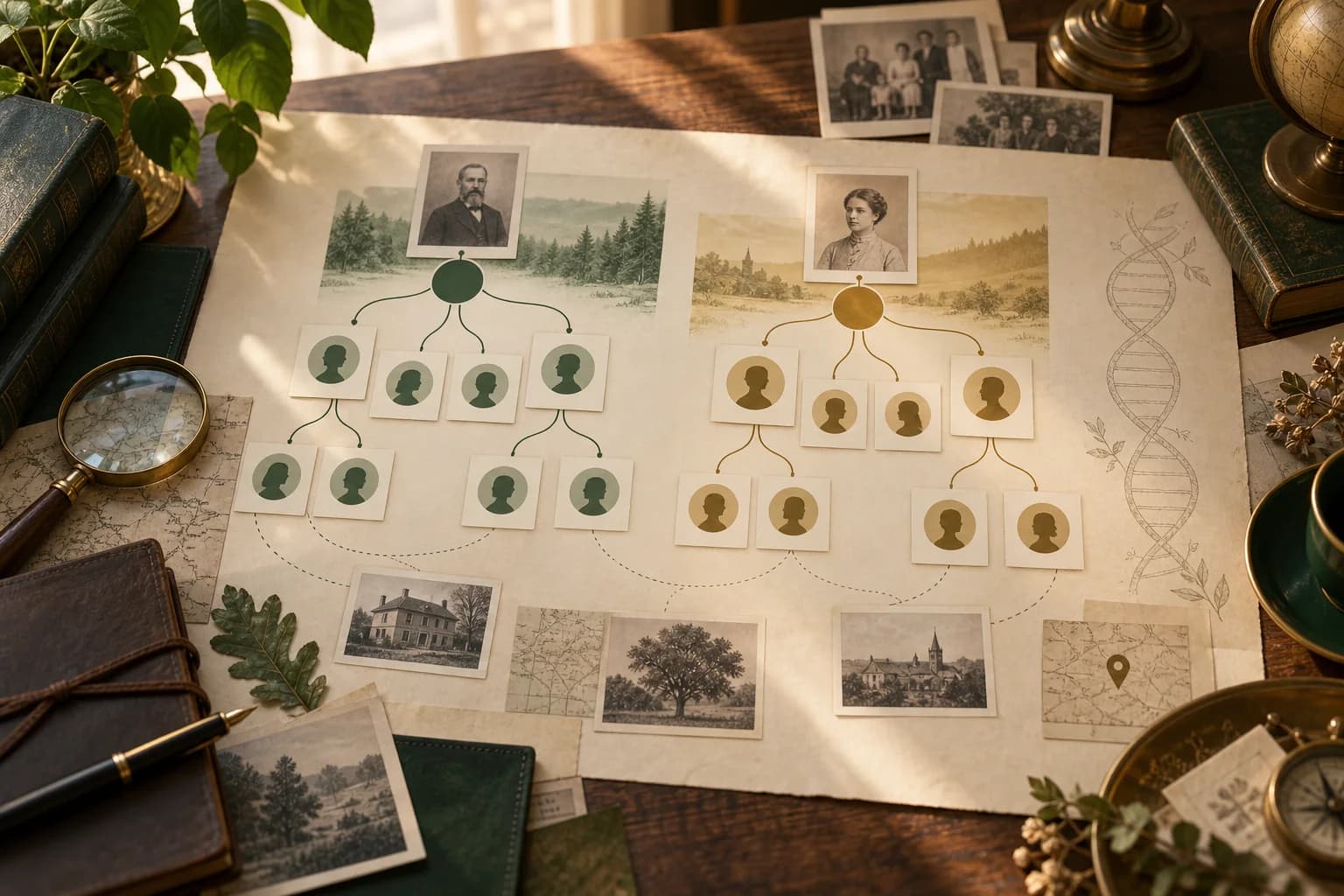
The process can organize a confusing match list into working groups that suggest where deeper documentary research should focus.
- Organizing matches into a working spreadsheet
- Grouping shared matches and building DNA clusters
- Separating maternal and paternal ancestral groups where evidence supports it
- Identifying probable grandparent branches and shared ancestor couples
- Noting clusters that require deeper tree research
- Building a research strategy from the cluster structure
Deliverables
A clearer view of your match landscape.
Deliverables depend on access, match coverage, tree quality, available records, and the agreed project scope.
Cluster map or grouping summary
Match grouping report
Research notes
Probable ancestral-line grouping
Unresolved-match list
Recommended next steps
Important DNA boundaries
DNA evidence guides research; it does not create certainty by itself.
DNA matches do not prove a relationship by themselves. Shared matches and cM values are interpreted alongside documentary evidence. Endogamy, pedigree collapse, incomplete trees, and testing coverage can affect interpretation. Results cannot be guaranteed.
Raw DNA files are not required for this service unless a future specific feature explicitly supports them. Viewer or shared access may be required to AncestryDNA or MyHeritage DNA, depending on the project. Never send passwords through forms, messages, or email.
Ask about DNA clusteringPhase 2
Investigative genealogy research can follow the clusters.
Clustering can guide deeper research into unknown parentage, unknown grandparentage, African American genealogy, DNA match tree building, census research, migration analysis, brick walls, common ancestor identification, and shared ancestral couples. This deeper work is quoted separately unless included in a custom scope.
FAQ
Clear boundaries before access is shared.
Can DNA matches prove a relationship by themselves?
No. DNA matches, shared matches, and cM values are interpreted alongside documentary genealogy evidence. They can guide hypotheses and research plans, but they do not prove a relationship alone.
Do you need my DNA password?
No. Never send passwords through forms, messages, or email. Viewer or shared access may be required depending on the project.
Which DNA sites are supported?
Supported sources may include AncestryDNA and MyHeritage DNA, depending on the available match tools and project scope.
Can clustering identify an unknown parent or grandparent?
It can help organize evidence and point research toward likely ancestral groups, but conclusions depend on testing coverage, available trees, documentary records, and the strength of the evidence.