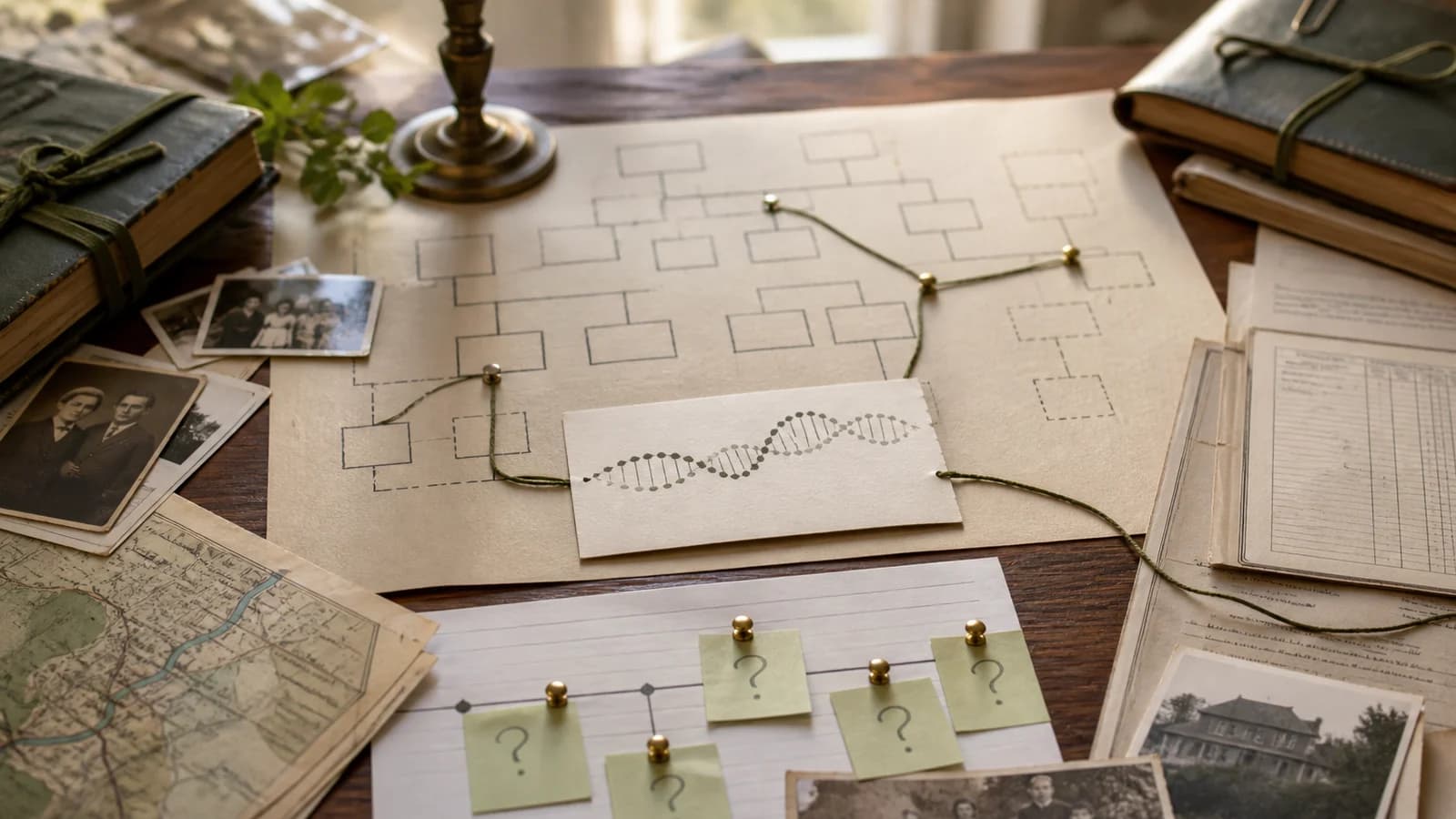

DNA is a clue, not a conclusion
Autosomal DNA can be one of the most useful clues in family-history research, especially when a paper trail is missing, incomplete, misindexed, or hidden behind changing names and migration. But a DNA match does not automatically identify the exact relationship or common ancestor.
Roots Adventure treats DNA evidence as part of a larger research process. A match, a shared-cM number, a predicted relationship, or a cluster of shared matches can point you toward a hypothesis. The conclusion still needs documentary evidence, family context, timelines, places, and careful reasoning.
Shared cM
Shared centimorgans, often written as shared cM, describe the total amount of autosomal DNA two people share. Larger amounts usually suggest a closer relationship, but the same cM amount can fit more than one relationship.
For example, a match around a few hundred cM may fit several cousin or half-relative possibilities. A higher match may point toward a closer family relationship, but it still cannot tell you whether the connection is maternal or paternal, older or younger, half or full, or which ancestor created the relationship.
Use shared cM to ask better questions:
- What relationship ranges are plausible?
- Which possibilities are impossible or unlikely?
- Which generation level fits the known ages?
- Which side of the family has shared matches with this person?
- Which records could confirm or disprove the leading hypothesis?
Range overlap
DNA relationship ranges overlap. That overlap is the reason a calculator should not give one forced answer. A predicted relationship is only a probability-shaped hint from the testing company or tool. It is not proof.
When ranges overlap, compare the DNA clue with:
- known ages and generations;
- parent, grandparent, and great-grandparent timelines;
- geography and migration paths;
- shared surnames and repeated places;
- shared matches;
- documentary evidence.
If two relationships remain plausible, keep both visible until records or additional DNA matches narrow the answer.
Predicted relationships are not proof
Testing companies may label a match as “second cousin,” “first cousin once removed,” or another predicted relationship. That label is an estimate. It can be useful, but it should never be copied into a family tree as a conclusion by itself.
The safer wording is:
- “The match is predicted as a possible second cousin.”
- “The shared cM range is consistent with several relationship classes.”
- “This is a working hypothesis pending documentary evidence.”
Shared matches
Shared matches are often more useful than the cM number alone. If several DNA matches all match you and each other, they may point to a shared ancestral line. The goal is to identify what the group has in common.
Look for:
- repeated surnames;
- repeated counties, towns, countries, or migration paths;
- trees that point to the same couple;
- records connecting families in the same place;
- clusters that appear on only one side of your family.
Shared matches still need care. A shared match group can contain more than one family line, especially in small communities or endogamous populations.
Maternal and paternal sorting
Before chasing a DNA match, try to determine which side of the family the match belongs to. Known matches are the best anchors. If a match also matches known maternal relatives but not known paternal relatives, that is a useful clue. The reverse is also useful.
Sorting does not always work neatly. Some matches may connect through both sides, through a distant common community, or through a relationship not represented in your current tree.
DNA clusters
A DNA cluster is a group of matches that appear to connect around a shared ancestral path. Clusters can help when you are researching unknown parents, unknown grandparents, misattributed parentage, adoption, missing records, surname changes, or brick walls.
Treat a cluster as a research workspace:
- give the cluster a temporary label;
- record the strongest matches first;
- note shared cM and testing company;
- record surnames, places, and time periods;
- list possible common ancestors;
- keep supporting and conflicting evidence separate.
Common ancestor research
The central question is often: which ancestor or ancestral couple explains this match group? Start by building from the documented trees of multiple matches, not from one unsourced online tree.
Common ancestor work is stronger when several independent records point toward the same family line. It is weaker when every path depends on copied trees, missing citations, or assumptions about a surname.
Unknown-parent and unknown-grandparent research
DNA can be powerful in unknown-parent research, but it can also reveal sensitive family information. Move slowly. Protect living people’s privacy. Avoid public accusations or public tree changes until the evidence is strong.
A careful unknown-parent workflow usually includes:
- sorting close matches by side;
- identifying shared match clusters;
- building private research trees for candidate families;
- comparing ages, places, and timelines;
- looking for documentary records that connect candidates to the right time and place;
- documenting uncertainty before contacting relatives.
Tree building from DNA
Do not attach a DNA match to your family tree just because a relationship looks likely. Build a research tree, floating tree, or private hypothesis space first. This keeps uncertain people and sensitive conclusions out of your main documented tree.
Tree-building from DNA should be evidence-led:
- Each person needs source support.
- Each relationship needs a reason.
- Each hypothesis needs an alternate explanation.
- Each conclusion needs records, not just DNA.
Age, generation, and geography
A DNA relationship can be genetically plausible but genealogically impossible. Always check:
- age difference;
- birth and death dates;
- whether a person could have been in the right place;
- migration routes;
- marriage and household context;
- local history and record availability.
The correct relationship should fit both the DNA and the human timeline.
Endogamy and pedigree collapse
Endogamy happens when people repeatedly marry within the same community over generations. Pedigree collapse happens when the same ancestors appear in a tree more than once. Both can make DNA matches appear closer than they are genealogically.
If your family comes from a small, isolated, or historically endogamous population, be extra cautious with shared cM and shared matches. Clusters may represent a community rather than one simple family line.
Documentary evidence still matters
DNA points the way; records build the case. Strong DNA-based research usually needs census records, vital records, church records, probate files, land records, newspapers, military records, immigration records, court files, oral history, photographs, and local context.
The conclusion should explain:
- what the DNA suggests;
- what the documents support;
- what conflicts remain;
- what has not been searched;
- why the chosen relationship is stronger than alternatives.
When to use professional genealogy help
Consider professional help when a DNA question involves an unknown parent, adoption, misattributed parentage, African American genealogy before 1870, international records, endogamy, sensitive living-person issues, or conflicting evidence that could affect real families.
Professional research cannot guarantee an answer. It can help build a careful plan, protect privacy, document sources, and avoid overclaiming what the evidence does not prove.
Helpful Roots Adventure tools and next steps
- Use the Relationship Calculator to understand plausible shared-cM ranges.
- Use the DNA Match Tracking Sheet to organize one match and its cluster.
- Use the Research Plan Builder to turn a DNA clue into a record-based plan.
- Explore DNA Match Clustering services when a question needs deeper human analysis.
Frequently asked questions
Can a DNA match prove the exact relationship?
Not by itself. A DNA match can support a relationship hypothesis, but the exact relationship usually requires documentary evidence, shared matches, timelines, and geography.
What does shared cM mean?
Shared cM is the total amount of autosomal DNA shared between two people. It helps identify possible relationship ranges but does not name the exact relationship.
Are predicted relationships reliable?
They are useful estimates, not proof. Treat them as starting clues.
What should I do first with a confusing match?
Record the match alias, shared cM, predicted relationship, shared matches, testing company, surnames, places, and the research question the match may help answer.
Should I upload raw DNA to public tools?
No Roots Adventure public tool asks for raw DNA uploads. Be cautious with any service that requests DNA files or living-person details, and read its privacy terms before using it.